Role Brand Strategist & Designer
Location Aizawl, Mizoram, India
Users University students, 18–25
Status MVP live · Full launch 2026
UX Case Study — Brand Strategy & Service Design

Laundry Point

Strategy is still design.

Launching a service nobody asked for yet — in a market with no frame of reference for it, real infrastructure constraints, and a monsoon season that turned out to be the best argument for coming back.

Affinity map

Laundry Point, Aizawl 2025 MVP launch
Context

A Market That Had No Frame of Reference for This.

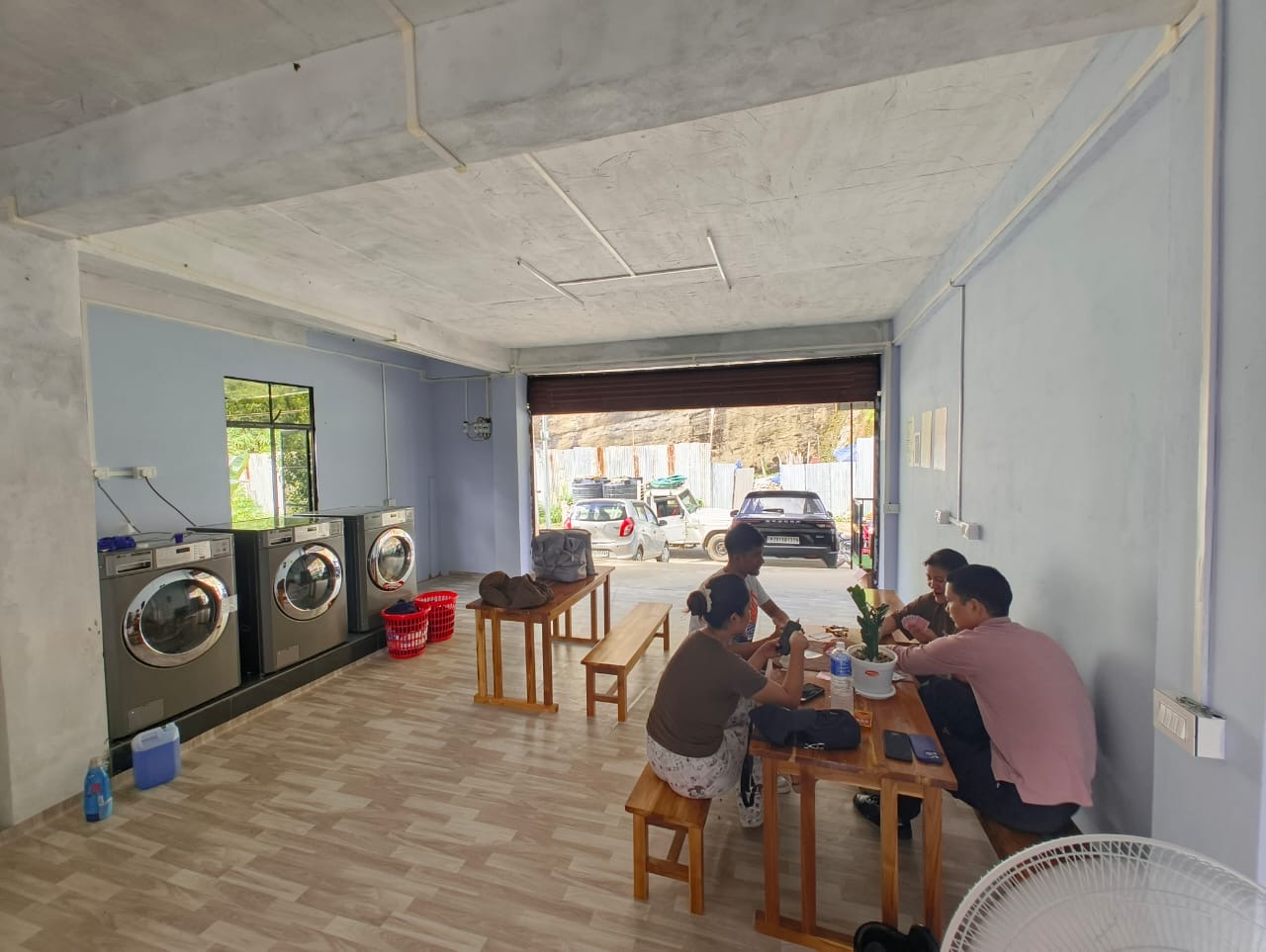
Mizoram is a hilly, landlocked state in Northeast India where most people either wash their own clothes or use a local dhobi service. The self-service laundromat is a normal part of life in the US and urban India. Here, it essentially didn't exist.

The challenge wasn't just building a brand. It was figuring out how to introduce a completely unfamiliar service to people who had no existing mental model for it — in a place with real infrastructure constraints working against the idea.

0

self-service laundromats in the local market before this

18–25

primary user age — students living independently for the first time

MVP

live and generating repeat visits from first-time users

2026

full launch with café element based on user feedback

Water Scarcity

Aizawl's hilly terrain makes water distribution unreliable and seasonal — the city's biggest infrastructure crisis. Every operational decision had to account for this.

Power & Connectivity

Weather regularly disrupts power and internet. A cashless-only payment model was never viable. The experience had to work when the network didn't.

Monsoon Season

Heavy rains make outdoor drying impossible for months. Clothes can take days to air-dry. What looked like an obstacle turned out to be one of the strongest reasons to try the service.

No Existing Mental Model

No pay-to-use laundry precedent locally. Every step of the experience — from entering to paying to collecting — had to be taught from scratch on the first visit.


Strategy

Don't Fight the Culture. Find Where It Bends.

My first recommendation wasn't about the logo or the interior. It was about location. Launching in a neighbourhood where traditional laundry habits were deeply embedded would mean spending most of the effort overcoming resistance. The smarter move was finding the audience most likely to try something new on their own terms.

Mizoram University provided exactly that — students living away from home, managing their own schedules, with no family infrastructure handling laundry for them. American culture has strong aspirational pull in the region, and the laundromat as a concept carried some of that association.

"The positioning didn't need to be complicated. Fast, affordable, and yours to control. That was the whole pitch."

Affinity map

Laundry Point, Aizawl 2025 MVP launch

Brand

It Needed to Feel Like Somewhere Worth Going.

The identity had to do two things simultaneously: feel familiar enough that a student from outside the region would recognise the register, and grounded enough that it didn't come across as imported or out of place locally.

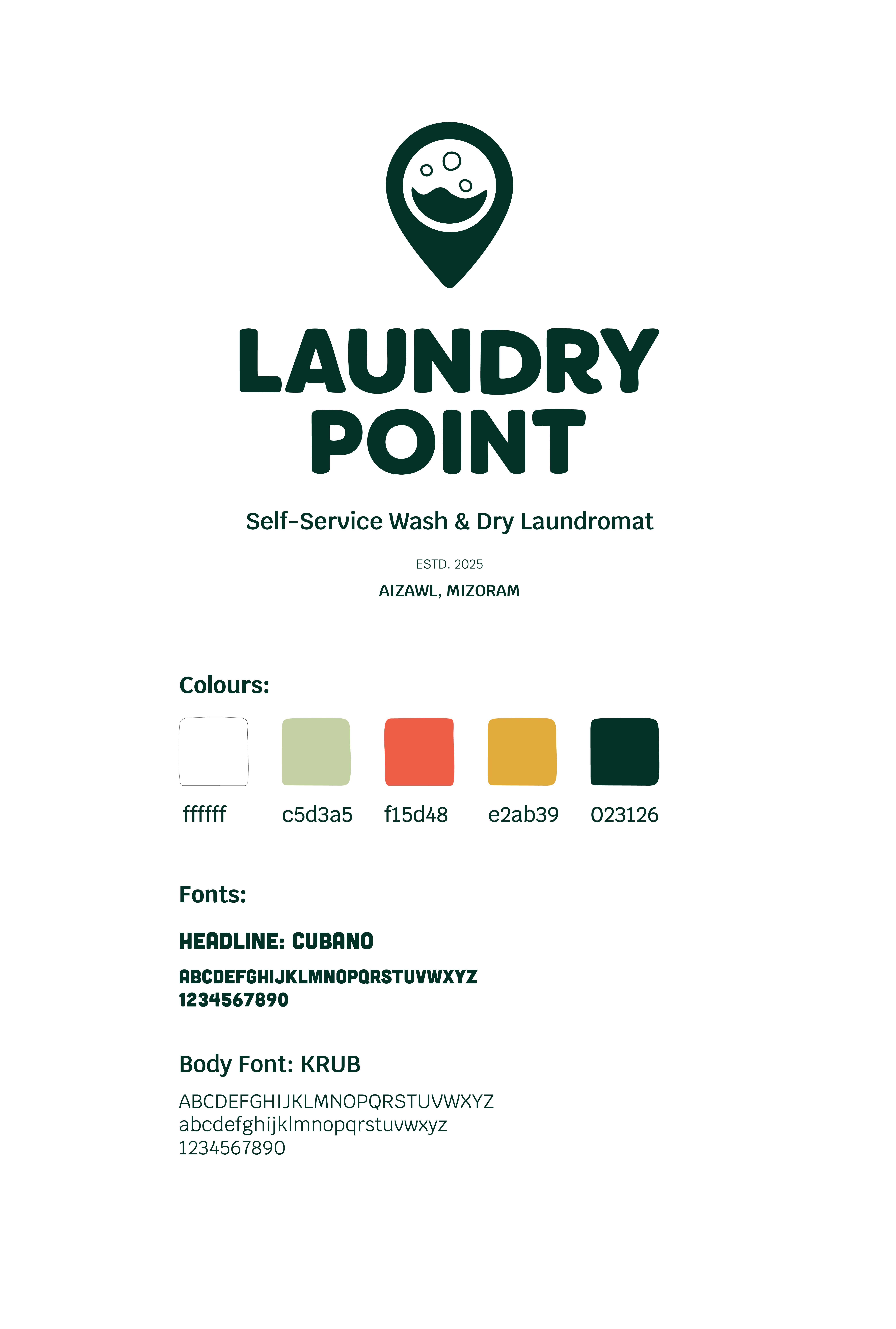
The logo works on three levels — a location pin, a washing machine drum, and a face. The name was chosen for simplicity: no unfamiliar terminology, easy to say and remember in any language. Coral leads the palette — energetic and warm — with gold as a grounding accent.

Affinity map

Laundry Point, Aizawl 2025 MVP launch
Affinity map

Laundry Point, Aizawl 2025 MVP launch

Service Design

The Experience Mattered More Than the Identity.

Getting the brand right was the easier part. The harder work was designing an experience someone could navigate on their first visit — with no prior knowledge, in a location where asking for help wasn't always comfortable.

01

Hybrid Payment

QR codes for students comfortable with digital. Cash kept available for when power or internet drops — which it does. A staff attendant handles transactions and doubles as a guide during the adoption phase. Cashless-only would have failed the first week.

02

Language

English throughout for the university audience. Local language signage is planned for the full launch to extend welcome beyond the student base to the broader community the business needs long-term.

03

The Monsoon Problem, Solved

Being able to collect clean, dry laundry in under an hour turned out to be one of the strongest reasons students kept coming back — not a selling point we led with, but the one that stuck.

04

The Waiting Experience

Users asked for somewhere to sit and have coffee while they wait. Card and board games were introduced in the MVP. A café element is planned for the full launch — a direct response to what users said, not a feature assumed from the start.

Affinity map

Laundry Point, Aizawl 2025 MVP launch


What the MVP Taught Us

One Validation and One Redesign.

The soft launch validated the core bet: students would try this and come back. What didn't work was the original in-store instruction design — bilingual text side by side was too busy for someone navigating the space for the first time.

V1 — Original instructions

Bilingual text (English + local language) displayed side by side. Full sentences, multiple steps visible at once. Too much cognitive load for a first-time visitor navigating an unfamiliar environment.

V2 — Revised instructions

Icon-based flow: Pay → Wash → Dry → Done. One action per panel. Minimal text. Scannable at a glance. Works regardless of which language the user is most comfortable in.

Affinity map

Laundry Point, Aizawl 2025 MVP launch

Affinity map

Laundry Point, Aizawl 2025 MVP launch


Outcomes

What Changed on the Ground.

Repeat Visits

MVP feedback confirmed the core hypothesis — students tried the service and returned. The monsoon drying advantage became the most-cited reason for coming back.

User-Driven Roadmap

The café element wasn't in the original brief. It came directly from what users said they wanted while waiting. The MVP produced a feature backlog from actual users, not assumptions.

Instruction Redesign

The bilingual text layout was replaced with an icon-based flow. One round of in-person observation produced a design change that reduced first-visit friction noticeably.

Where It Falls Short

Extending beyond the university audience — to older users less familiar with the concept — remains the hardest design problem still open. The language expansion to local signage is planned but not yet live.

Full launch — 2026

Local language signage, expanded payment options, the café element, and a second location assessment based on MVP data. This case study will be updated as each phase completes.


Reflection

Strategy Is Still Design.

The decision that shaped everything on this project wasn't visual. It was the recommendation to launch near a university rather than try to convert an audience that wasn't ready. Every downstream choice — the tone, the payment model, the language, the waiting area — became cleaner because the user was right.

What the MVP also confirmed is that iteration in a market with no prior context is slower than iteration in a market where users already have expectations. People can't tell you what they expected when they had no expectations to begin with. The icon instruction redesign came from watching people use the space — not from asking them what they wanted. In low-familiarity contexts, observation is more useful than surveys.


More work

Next Case Study